
Meta – Momo Division – Cameroon
Meta Cooperation Company PLC (MCC PLC) operates within Meta, a region located in Momo Division, Cameroon, characterized by fertile land, strong agricultural heritage, established market activity, and significant natural resources.
This White Paper presents a structured overview of the region’s economic potential, focusing on land assets, agriculture, livestock, fisheries, palm oil, coffee production, and market infrastructure. It outlines a high-level, compliance-aligned framework for agricultural value-chain development, anchored by Tad Market and guided by principles of sustainability, community participation, and regulatory compliance.
This document is provided for informational and strategic planning purposes only and does not constitute a guarantee of outcomes, returns, or production volumes.
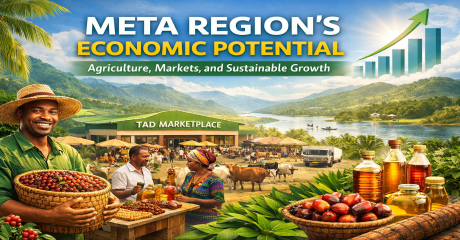
Meta serves as a central commercial and agricultural region within Momo Division, supporting trade, farming activities, and regional exchange. Tad Market plays a critical role in connecting rural production areas with traders and consumers across the division and neighboring regions.
The region benefits from:
Strategic geographic positioning
Established market activity
Proximity to agricultural and grazing zones
Natural water resources
These factors collectively support long-term, market-driven economic development.
The Meta area is surrounded by significant land assets, including:
An abandoned cooperative site comprising more than 2 hectares
The Medino area, with over 3 hectares of land
Additional surrounding land suitable for agriculture, grazing, storage, and commercial infrastructure
All land-related initiatives are subject to applicable land tenure laws, municipal approvals, and community consultation processes.
The River Nyen, which flows across parts of the Meta area, supports agricultural activity, fisheries potential, and environmental planning. Any utilization of water resources is governed by environmental regulations and sustainability standards.
Agriculture has historically formed the backbone of the Meta regional economy. Favorable climatic conditions, fertile soils, and longstanding farming practices support diverse crop cultivation and value-chain development opportunities.
One of the primary agricultural products of the Meta region is palm oil, locally known as Meta Palm Oil.
Meta Palm Oil is widely recognized within Cameroon and neighboring regions for its quality, traditional processing methods, and cultural significance. Palm oil production contributes to household livelihoods, local trade, and food supply chains and remains a defining element of the region’s agricultural identity.
Any future palm oil–related initiatives will be subject to environmental regulations, sustainable agricultural practices, and market feasibility assessments.
Coffee has historically been a major economic pillar in the Meta region.
The Meta Cooperative reportedly produced more than 1,000 tons of coffee per year during its peak period.
Broader regional accounts indicate that Robusta coffee production in the wider Meta area reached up to approximately 7,000 tons per year during favorable historical periods.
This historical performance demonstrates agro-ecological suitability, established farming knowledge, and regional relevance for Robusta coffee production. Historical figures are provided for contextual understanding only and do not represent future guarantees.
The Meta region contains extensive grazing land supporting livestock activities, including cattle, sheep, goats, and other animal husbandry systems. Livestock production contributes to food security, rural incomes, and regional trade, particularly through Tad Market.
Natural water boundaries and aquatic environments provide potential for artisanal fisheries and small-scale aquaculture initiatives, subject to environmental safeguards and regulatory compliance.
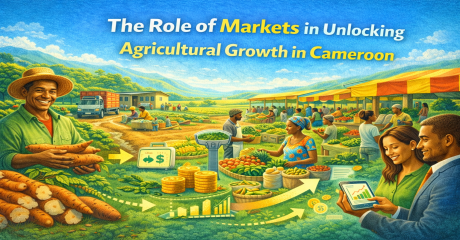
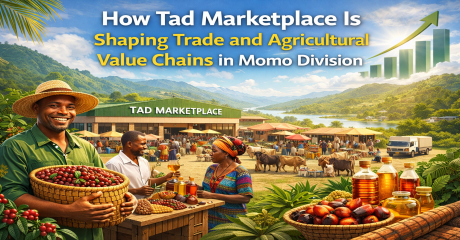
Tad Market, Meta functions as the primary commercial exchange point within Momo Division. Its strategic position enables aggregation, storage, and trade of agricultural and livestock products.
Future development of Tad Market may support:
Agricultural aggregation and logistics
Storage and handling facilities
Multi-commodity trade
Support services for farmers and traders
Any market development initiatives will follow feasibility studies, municipal planning frameworks, and stakeholder engagement processes.
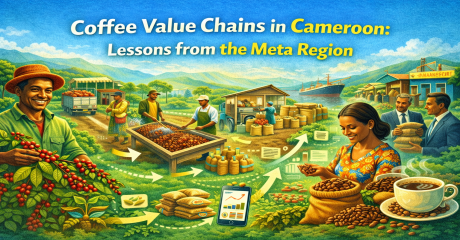
Building on historical coffee production capacity, a structured coffee value-chain framework may be explored to enhance quality, efficiency, and market access for Robusta coffee.
The framework emphasizes value creation rather than volume expansion.
Potential components include:
Sustainable Cultivation – improved agronomic practices and quality enhancement
Aggregation and Storage – structured collection systems linked to Tad Market
Processing and Value Addition – drying, grading, and packaging
Market Access – domestic, regional, and compliant international trade channels
All components are subject to feasibility, compliance, and environmental considerations.
Agricultural and technical feasibility studies
Farmer engagement and baseline assessments
Pilot clustering and quality testing
Expanded participation
Aggregation and storage facilities
Quality control and traceability systems
Integration with Tad Market
Trade partnerships
Branding and structured commercialization
All initiatives described in this White Paper are subject to:
Regulatory and municipal approvals
Environmental and social impact assessments
Community participation
Market conditions and economic feasibility
MCC PLC does not guarantee production volumes, revenues, or investment outcomes. Participation in economic activities involves risk.
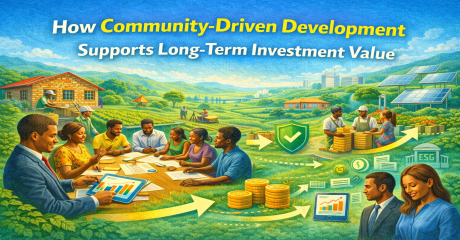
MCC PLC views collaboration with municipal authorities, traditional institutions, and community stakeholders as essential. All proposed initiatives are intended to complement local development priorities and operate within established legal and regulatory frameworks.
The Meta region’s combination of land assets, agricultural heritage, livestock capacity, water resources, and market infrastructure presents meaningful long-term economic potential. Through structured planning, regulatory compliance, and stakeholder collaboration, MCC PLC seeks to support sustainable, transparent, and inclusive development initiatives that strengthen regional value chains and economic resilience.
End of White Paper