
Author: Tomfon Ngangyet
Agriculture remains one of the most important pillars of Cameroon’s economy, employing a large portion of the population and contributing significantly to food security, rural livelihoods, and national development. However, the true potential of agriculture is realized not only through production, but through effective agricultural value-chain development.
Understanding how agricultural value chains function—and how they can be strengthened—is essential for building a more resilient, inclusive, and sustainable agricultural sector in Cameroon.
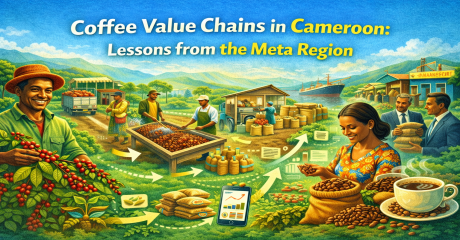
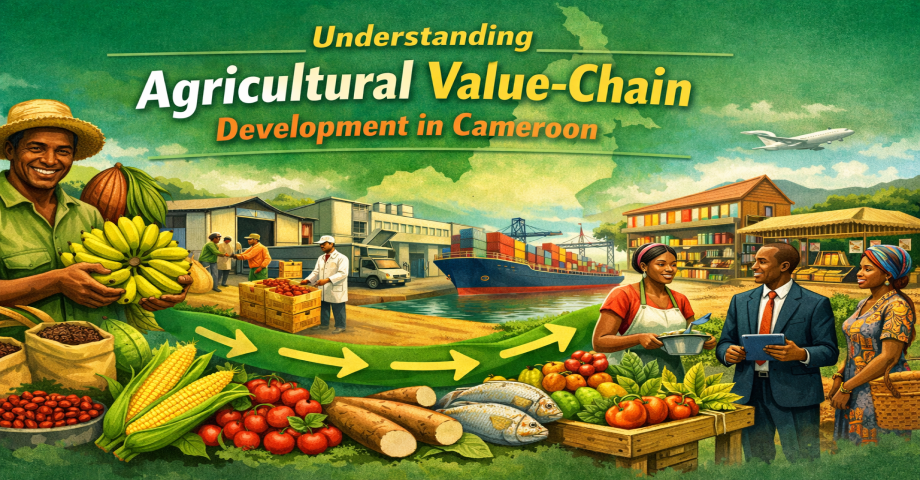
An agricultural value chain refers to the entire sequence of activities involved in bringing an agricultural product from production to the final consumer. This typically includes:
Input supply (seeds, tools, fertilizers)
Farming and production
Aggregation and storage
Processing and value addition
Transportation and logistics
Marketing and trade
Final consumption
Each stage adds value to the product, creates employment, and generates income when properly coordinated.
Cameroon has diverse agro-ecological zones, fertile land, and a strong tradition of farming. Yet many farmers remain trapped at the production stage, selling raw products at low prices. Value-chain development helps to address this challenge by:
Reducing post-harvest losses
Improving product quality and consistency
Expanding market access
Increasing farmer incomes
Encouraging local processing and job creation
By strengthening linkages between farmers, markets, processors, and consumers, value-chain development transforms agriculture into a driver of inclusive economic growth.
Several agricultural sectors in Cameroon offer strong value-chain potential, including:
Maize, cassava, rice, plantains, and vegetables are staples with opportunities for processing, storage, and improved distribution.
Coffee, cocoa, and palm oil have long histories in Cameroon and remain important export and domestic commodities when supported by quality control and value addition.
Cattle, goats, sheep, and poultry contribute to food security and trade, especially when supported by grazing management, veterinary services, and organized markets.
Artisanal fisheries and aquaculture offer opportunities for nutrition, income generation, and regional trade.
Despite strong potential, agricultural value-chain development in Cameroon faces several challenges:
Limited access to finance for farmers and processors
Inadequate storage, processing, and transport infrastructure
Weak market coordination and price volatility
Limited access to technical training and modern practices
Environmental and climate-related risks
Addressing these challenges requires coordinated action across public, private, and community stakeholders.
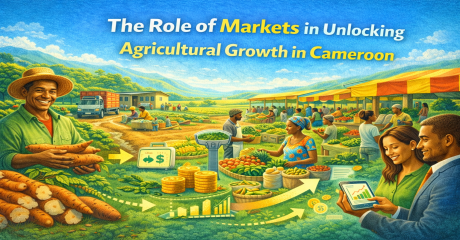
Markets play a central role in agricultural value chains. Well-organized marketplaces act as hubs for:
Aggregation of agricultural products
Price discovery and transparency
Linkages between producers and buyers
Support services such as storage and logistics
Improving market infrastructure—especially in rural and semi-urban areas—helps reduce inefficiencies and strengthens the entire value chain.
Sustainable agricultural value-chain development must prioritize:
Environmental protection
Responsible land and water use
Climate-resilient practices
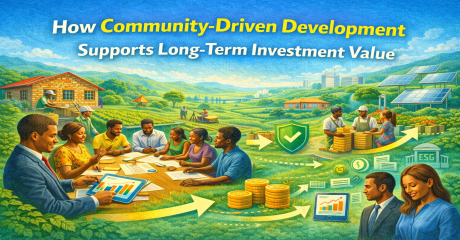
Inclusion of smallholder farmers and local communities
Community participation ensures that value-chain initiatives are locally relevant, socially accepted, and economically viable over the long term.
The future of agriculture in Cameroon depends on moving beyond production alone and embracing integrated value-chain development. By investing in skills, infrastructure, market access, and governance, agricultural value chains can:
Increase national food security
Strengthen rural economies
Attract responsible investment
Support sustainable growth
Agricultural value-chain development is not a quick fix, but a long-term strategy for transforming Cameroon’s agricultural potential into shared prosperity.
Understanding and strengthening agricultural value chains is essential for unlocking Cameroon’s agricultural potential. Through coordinated efforts that connect farmers, markets, processors, and consumers, agriculture can evolve into a resilient and inclusive engine of economic development.